
Why a Dexa Scan Is One of the Most Important Tests for Longevity
The scale is one of the most misleading tools in health.
It gives you a number.
It feels objective.
It drives decisions.
And it misses what actually matters.
Lose 10 pounds? That could mean progress.
It could also mean muscle loss, slower metabolism, and a worse long-term trajectory.
The scale won’t tell you the difference.
If you’re trying to improve your health, reduce long-term risk, or stay active into your 80s and 90s, you need a better signal.
That’s where a DEXA scan comes in.

Weight compresses everything into a single number:
Muscle
Fat
Bone
Water
All treated the same.
From a longevity perspective, those variables behave very differently.
Muscle:
Improves metabolic health
Reduces risk of falls and injury
Correlates with longer healthspan
Visceral fat:
Increases risk of heart disease
Drives insulin resistance
Linked to inflammation and mortality
Bone density:
Determines fracture risk
Impacts mobility and independence
A 180-pound body can be:
Strong and metabolically healthy
Or fragile and high-risk
The scale treats them as identical.
That’s the core issue.
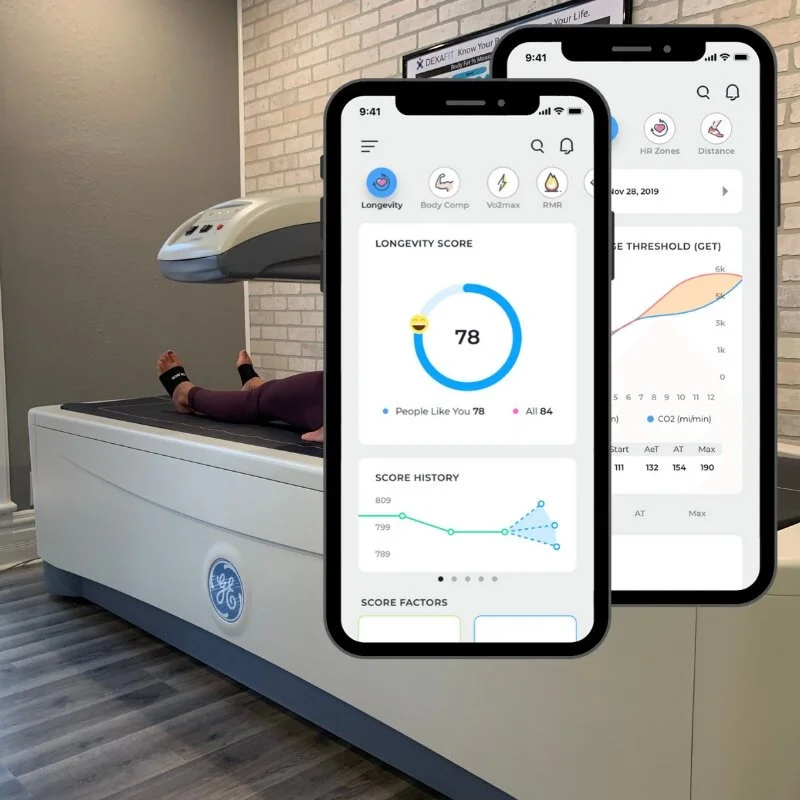
What a DEXA Scan Measures
DEXA (Dual-Energy X-ray Absorptiometry) breaks your body into three components:
Lean mass (muscle)
Fat mass (including visceral fat)
Bone mineral density
Instead of asking:
👉 “Did I lose weight?”
You can ask:
👉 “Did I improve my body composition?”
That shift changes everything.
Because longevity isn’t about being lighter.
It’s about being:
Stronger
More resilient
Less likely to break down over time
1. It Redefines What Progress Actually Looks Like
One of the biggest mistakes in health is chasing the wrong outcome.
The scale encourages that.
A drop in weight feels like progress—even when it isn’t.
In my own case:
~10 lbs of muscle gained
~20 lbs of fat lost
The scale showed:
👉 Down 10 pounds
That’s it.
It completely missed the real transformation.
Without DEXA, the takeaway would have been:
“Some progress.”
With DEXA, the takeaway was:
“Massive improvement in health trajectory.”
That difference matters.
Because:
Muscle supports longevity
Fat distribution drives disease risk
Bone density determines long-term mobility
Progress needs to reflect those variables—not just weight.
2. It Turns Plateaus Into Clear Decisions
Plateaus are where most people get stuck.
Effort stays high. Results stall.
Without data, the response is usually:
Try something new
Or give up
Neither works particularly well.
DEXA changes the equation.
Instead of guessing, you can see:
Muscle gain stalled
Fat loss plateaued
Visceral fat unchanged
That leads to specific adjustments:
Increase protein intake
Modify training intensity
Improve recovery
Adjust caloric balance
The key difference:
👉 You’re not changing everything
👉 You’re changing the right thing
That’s how progress resumes.
3. It Identifies Visceral Fat—The Risk You Can’t See
Not all fat behaves the same.
Subcutaneous fat:
Sits under the skin
Largely cosmetic
Visceral fat:
Surrounds organs
Metabolically active
Strongly linked to disease
Higher visceral fat is associated with:
Cardiovascular disease
Type 2 diabetes
Chronic inflammation
Increased mortality
Here’s the problem:
You can’t see it.
Two people can look nearly identical:
Same weight
Similar body fat %
Similar lifestyle
But have very different visceral fat levels.
I’ve seen:
~0.5 lbs vs ~3+ lbs
That’s a completely different risk profile.
And it leads to different recommendations:
One focuses on muscle gain
The other prioritizes fat loss
Without DEXA, that distinction is invisible.
4. It Detects Bone Loss Early—When It’s Still Reversible
Bone density rarely gets attention early.
Guidelines often suggest testing at 65.
That’s too late for prevention.
Bone loss starts much earlier—especially for women.
A DEXA scan can reveal:
Low bone density
Early osteopenia
Structural risk before symptoms
This matters because:
Fractures later in life are often life-altering
Recovery becomes harder with age
Mobility loss compounds quickly
A real example:
My wife:
Highly active
Training consistently for years
DEXA revealed:
👉 Low bone density in her early 40s
No symptoms. No warning signs.
From there, small adjustments:
Heavier resistance training
Increased protein intake
Creatine + Vitamin D
Within months:
👉 Significant improvement
That only happens if you catch it early.
5. It Aligns Your Strategy With Longevity—Not Aesthetics
A lot of health decisions are driven by aesthetics.
Weight
Body fat %
Appearance
Longevity operates differently.
The key drivers are:
Muscle mass
Bone density
Visceral fat
Metabolic health
DEXA shifts the focus toward those.
Instead of:
“Lose 15 pounds”
You get:
Build X lbs of muscle
Reduce visceral fat
Improve bone density
That leads to better decisions in:
Training
Nutrition
Recovery
And ultimately:
👉 Better long-term outcomes
Age-Specific Guidance:
When to Use DEXA
20s–30s
Establish baseline
Understand natural body composition
Build muscle early
40s–50s
Monitor muscle decline
Track visceral fat
Identify early bone loss
60+
Preserve muscle
Maintain bone density
Reduce fall risk
For women in particular:
👉 Waiting until 65 misses the window for meaningful prevention
How DEXA Compares to Other Methods
| Method | What It Measures | Accuracy | Value |
|---|---|---|---|
| Scale | Total weight | Low | Misleading |
| BMI | Height vs weight | Very low | Often irrelevant |
| Smart Scale | Estimated body fat | Inconsistent | Limited |
| InBody | Electrical impedance | Moderate | Directional |
| DEXA | Muscle, fat, bone, visceral fat | High | Actionable |
At-home tools can be useful for trends.
DEXA provides:
👉 Precision
👉 Consistency
👉 Clinical-level insight
The Missing Piece: Data Without a Plan Doesn’t Work
Testing alone doesn’t improve health.
That’s where people get stuck.
They:
Get the scan
Look at the results
Don’t change anything
Or worse:
Misinterpret the data
Overcorrect
The value of DEXA comes from:
👉 What you do next
The real process is:
Measure
Interpret
Prioritize
Act
Re-test
Without that loop:
👉 It’s just information
With it:
👉 It becomes a strategy
Key Takeaways
Weight is a weak signal
Body composition is a strong signal
Visceral fat drives risk
Muscle and bone drive longevity
And the most important point:
👉 You can’t optimize what you don’t measure
A DEXA scan doesn’t just give you numbers.
It gives you direction.
A DEXA scan shows what your body is actually made of—not just what it weighs.
At Longevity Health, we use DEXA alongside bloodwork, VO₂ max testing, and physician-led guidance to build a personalized plan that actually moves the needle.
Because the goal isn’t more data.
👉 It’s a better trajectory.
If you want help interpreting your results and building a plan: