
CGM for Non-Diabetics: What I Learned Wearing a Glucose Monitor
I thought I had my nutrition dialed in.
I was working out consistently. Eating relatively clean. Tracking calories, protein, fiber. By most standards, I was doing everything “right.”
Then I wore a continuous glucose monitor.
Within a few days, it was obvious I was guessing.
That’s the part no one talks about with nutrition. You can follow all the right principles and still miss what actually matters for your body.

The growing interest in CGMs for non-diabetics makes sense.
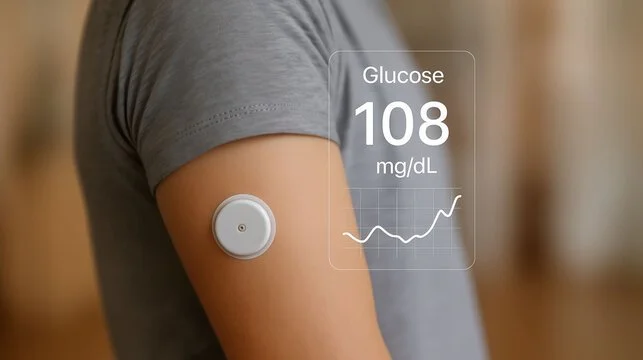
They give you real-time feedback on how your body responds to food, stress, sleep, and exercise. That’s something traditional lab work can’t do. A fasting glucose or A1C gives you a snapshot. A CGM gives you a movie.
We include CGMs in our program for this exact reason. They can surface insights that aren’t obvious otherwise .
But I didn’t go into this thinking it would change everything. I expected marginal insights.
That’s not what happened.
What Changed After Wearing One
The biggest shift wasn’t in what I learned about specific foods. It was how I started thinking about metabolic health.
Before the CGM, I thought in terms of inputs:
What am I eating?
How many calories?
How much protein?
After the CGM, I started thinking in terms of response:
What is my body actually doing with this?
That’s a very different lens.
A few patterns stood out immediately, and they’ve held up over time.
First, the gap between “healthy” and “works for me” is bigger than most people realize.
There are foods that are widely considered healthy that still produced significant glucose spikes for me depending on timing, context, and what I paired them with. Oatmeal is a good example. On its own, it created a very different response than when combined with protein and fat.
This reinforces something I’ve seen over and over in practice: there’s no single diet that works for everyone. Tradeoffs exist everywhere, and the right approach depends on your biology, goals, and preferences .
Second, small adjustments had outsized impact.
Changing the order of meals—protein and fiber first, carbs last—flattened spikes without changing the actual foods. Adding a 10-minute walk after meals consistently improved glucose response.
These aren’t extreme interventions. They’re small, targeted changes that are easy to sustain.
That’s an important theme. The goal isn’t to overhaul your life. It’s to identify the few levers that actually move the needle.
Third, sleep showed up everywhere.
Poor sleep didn’t just make me feel worse the next day. It showed up directly in the data: higher baseline glucose, bigger spikes, slower recovery. The same meals produced worse responses.
That’s consistent with what we see more broadly. Sleep is one of the highest return-on-time investments in longevity. Improving quality often matters more than trying to add more hours .
Finally, stress had a measurable metabolic cost.
Even without changes in diet, periods of higher stress led to worse glucose control. That’s not surprising physiologically, but seeing it in real time makes it harder to ignore.
Where CGMs Get Misused
The tool is powerful, but it’s easy to use it the wrong way.
The most common mistake is overreacting to individual data points.
Glucose is supposed to rise after you eat. A spike isn’t inherently a problem. The issue is persistent patterns—repeated large spikes, slow recovery, or elevated baseline levels.
Looking at a single meal and deciding something is “bad” misses the point.
Another mistake is turning it into food fear.
I’ve seen people eliminate entire categories of food because of one reading. That’s not a sustainable strategy, and it often ignores the broader nutritional context.
There’s a difference between optimizing and overcorrecting.
The bigger issue, though, is treating glucose as the primary metric of health.
It’s not.
Metabolic health matters, but it’s one piece of a much larger system. You can have perfect glucose control and still be far from optimal if your fitness, muscle mass, or cardiovascular health are lacking.
VO₂ max is a good example. It reflects how well your entire system—heart, lungs, muscles—works together and is one of the strongest predictors of long-term health and lifespan .
If you’re only looking at glucose, you’re missing that.
How I Think About CGMs Now
I don’t use a CGM continuously.
I use it as a tool to answer specific questions.
A few weeks at a time, once or twice a year, is usually enough to:
Identify patterns
Test changes
Validate what’s working
Then I move on.
The goal isn’t constant monitoring. It’s better decision-making.
This is a broader theme in longevity. Data is only useful if it leads to action. Testing without a plan doesn’t improve anything.
Wearing a CGM didn’t introduce new fundamentals.
It reinforced the ones that actually matter.
Exercise, sleep, caloric balance, and body composition are still the foundation. The difference is how precisely you apply them.
That’s where tools like CGMs can be helpful. Not because they replace the basics, but because they help you execute them better.
There’s a tendency to look for a shortcut in longevity—a device, a supplement, a protocol that solves everything.
That’s not how this works.
The people who get the best results aren’t doing something radically different. They’re doing the basics with more clarity, more consistency, and a plan that fits their life.

Where to Go From Here
If you’re thinking about using a CGM, the question isn’t whether it works.
The question is whether you have a strategy for what to do with the data.
Because without that, it’s just another graph.
If you want help building a personalized plan—whether that includes CGMs, bloodwork, or other diagnostics book a consult.
That’s where this becomes actionable.